





Building strength usually means lifting progressively heavier weights. But what if heavy loading is off the table, perhaps because you are recovering from surgery, nursing a painful joint, or simply cannot tolerate the strain? This is where blood flow restriction training, often shortened to BFR, offers a genuinely useful alternative. It allows meaningful strength and muscle gains using surprisingly light loads.
It can look unusual at first glance, but the method is grounded in a growing body of research and is increasingly used within physiotherapy and rehabilitation. Here is how it works and where it can help.
What Is Blood Flow Restriction Training?
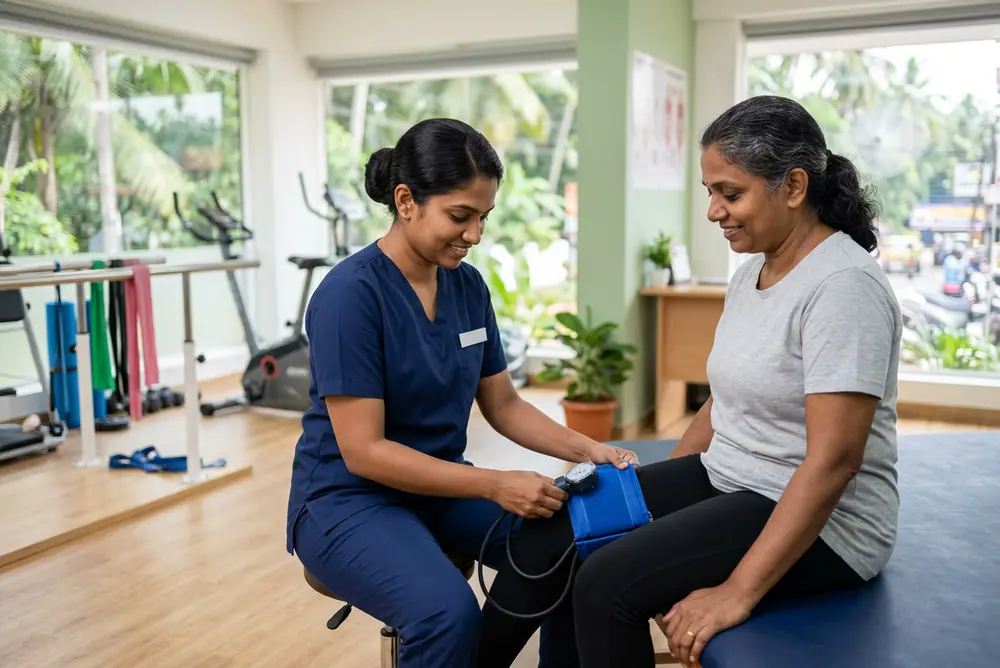
BFR uses a specialised cuff, a little like a blood pressure cuff, placed around the top of a limb to partially restrict blood flow while you exercise with light loads. The cuff is not meant to cut off circulation completely. It reduces flow just enough to create a demanding environment within the working muscle, even though the weight in your hands is modest.
The result is that a light exercise feels far more taxing to the muscle than the load alone would suggest. This is what lets people train productively when heavy weights are not an option.
How Can Light Weights Build Muscle?
Normally, significant muscle growth is associated with lifting heavy. BFR appears to change that equation. By restricting flow, it creates conditions inside the muscle that drive an adaptation response similar to heavy lifting, despite using loads of roughly 20 to 40 percent of your maximum.
The evidence here is encouraging. Systematic reviews show that low-load BFR can produce muscle growth similar to heavy resistance training. It is worth being balanced, though: peak strength gains are often somewhat lower than with heavy lifting. So BFR is an excellent tool when heavy training is not possible, rather than a wholesale replacement for it when it is.
BFR shines precisely when heavy lifting is off the table, letting you protect a healing joint while still challenging the muscle.
Where BFR Helps Most in Rehab
The real value of BFR shows up in rehabilitation, where heavy loading is often unsafe or simply too painful early on. Muscles tend to waste quickly after injury or surgery, and rebuilding them without stressing healing tissue is a constant challenge. BFR helps square that circle.
- Early after ACL reconstruction or other surgery, when the joint cannot yet tolerate heavy loads
- Painful joints such as an irritable knee, where heavy resistance would flare symptoms
- Frail or older patients, for whom heavy lifting may be unsuitable or unsafe
- Preserving muscle during periods of reduced activity or restricted weight-bearing
This makes BFR a valuable addition within our post-surgical rehabilitation programmes, helping people hold onto and rebuild strength at a stage when their body simply cannot handle a heavy barbell.
Is It Safe? The Role of Supervision
Used correctly, BFR is considered safe for suitable people, but that phrase matters. It must be done under trained supervision, with proper screening beforehand to check it is appropriate for you. Cuff pressure and placement, the right load, and your individual medical history all need to be judged by a professional. Certain conditions may make BFR unsuitable, which is exactly why the screening step is not optional.
Our musculoskeletal and sports physiotherapy team can assess whether BFR is a sensible fit for your goals and stage of recovery, and integrate it into a broader plan rather than using it in isolation.
| Feature | Heavy resistance training | Low-load BFR |
|---|---|---|
| Load used | Heavy | Light, around 20 to 40% of max |
| Muscle growth | Strong | Similar in reviews |
| Peak strength gains | Highest | Often somewhat lower |
| Best when | Heavy loading is safe | Heavy loading is not safe or too painful |
Frequently Asked Questions
How can light weights build as much muscle as heavy lifting?
By partially restricting blood flow with a cuff, BFR creates a demanding environment inside the muscle that drives growth despite light loads of around 20 to 40 percent of your maximum. Systematic reviews show muscle growth similar to heavy training, though peak strength gains are often somewhat lower.
Is blood flow restriction training safe?
Used correctly, it is considered safe for suitable people, but it must be done under trained supervision with proper screening first. Cuff pressure, load and your medical history all need professional judgement, and some conditions may make it unsuitable.
Who benefits most from BFR?
It is especially useful when heavy loading is not safe, for example early after ACL reconstruction or other surgery, for painful joints, and for frail or older patients. It helps rebuild and preserve muscle without stressing healing tissue.
Can I try BFR at your Kakkanad clinic?
The first step is an assessment to check BFR is appropriate for you and to fit it into a wider rehabilitation plan. Call +91 80894 14419 to arrange one. We are open every day from 8:00 AM to 10:00 PM.
Rebuilding Strength After Injury or Surgery?
Book an assessment with Dr. Noora at Proud Physio & Wellness, Kakkanad, and find out whether BFR fits your recovery.
Call +91 80894 14419 Book Online