



If you have been told you have knee osteoarthritis, you may assume that a joint replacement is only a matter of time. It is one of the most common worries we hear at our clinic. Yet the evidence has shifted decisively, and the message from modern guidelines is clear: for most people, exercise, not surgery, is the first treatment.
This is not about avoiding surgery when it is genuinely needed. It is about giving conservative care a proper chance first, because for a great many people it works remarkably well.
What the Guidelines Actually Say
The major international guidelines, including NICE in the UK, OARSI and the ACR, all agree. They recommend exercise, education and weight management as the core, first-line treatment for knee osteoarthritis, ahead of medication and surgery. Joint replacement is reserved for people who are not adequately helped by conservative care.
In other words, the operating theatre is not the starting point. It is the option kept in reserve for when a well-delivered programme of exercise and education has not given enough relief. Our knee pain condition page sets out how we assess and grade this for each person.
Why Exercise Works for an Arthritic Knee
It can seem counter-intuitive to load a painful joint, but strong muscles around the knee act like shock absorbers, sharing the forces that would otherwise fall on the joint surfaces. Exercise also improves balance and control, reduces stiffness, and helps the whole limb move more efficiently. Losing even a modest amount of weight, where relevant, further lowers the load through the joint with every step.
Education matters just as much. Understanding that hurt does not always mean harm, and that a knee with arthritis can be safely and gradually strengthened, changes how confidently people move.
The GLA:D Programme: Evidence in Action
One of the best examples of this approach is the GLA:D programme, which stands for Good Life with osteoArthritis in Denmark and has been running since 2013. It combines education with about twelve supervised neuromuscular exercise sessions, delivered by trained physiotherapists.
Its registry, which tracks large numbers of real patients, reports meaningful improvements. Pain scores improve by roughly twelve to fourteen points on a nought-to-hundred scale at three to twelve months, and painkiller use falls from about fifty-six per cent to about thirty-seven per cent of participants. These are the kinds of gains that can transform daily life without any operation at all.
A knee replacement is a good operation, but it is not the only answer. For most people, a structured exercise and education programme is where recovery should begin.
What About Meniscal Tears?
Many people over forty are told a scan shows a meniscal tear and are offered keyhole surgery. Here too, the evidence has moved. For degenerative meniscal tears, the sort linked to normal ageing rather than a fresh sporting injury, high-quality trials have found exercise therapy to be non-inferior to arthroscopic surgery. The ESCAPE trial, published in the BMJ in 2016 with five-year follow-up in 2022, is a leading example. In practice, that means a well-designed exercise programme can be a reasonable first choice for many of these tears.
How We Deliver This in Kakkanad
| Stage | What it involves |
|---|---|
| Assessment | Understanding your knee, goals, strength and daily activity |
| Education | Learning what osteoarthritis is, and what helps and what does not |
| Neuromuscular exercise | Supervised, progressive strengthening and control work |
| Progression | Building load and confidence, with weight management where useful |
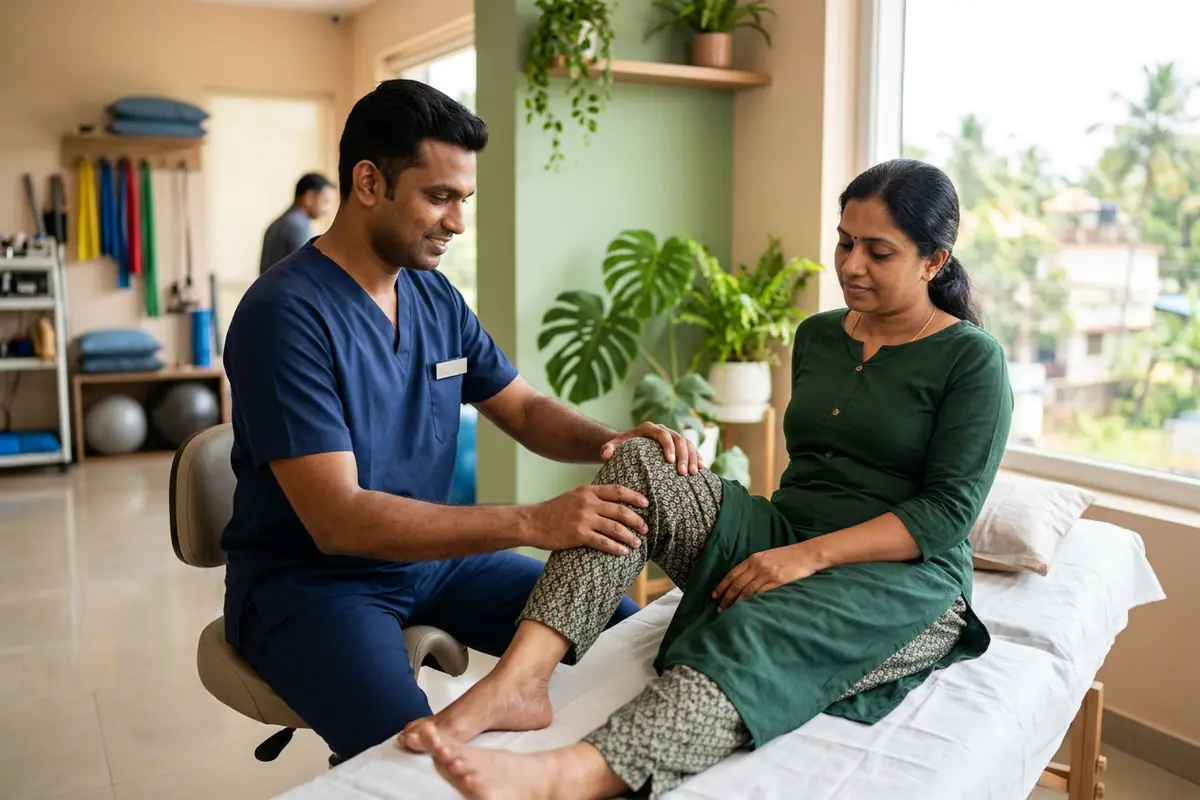
Our musculoskeletal physiotherapy service follows exactly this evidence-based structure, with a personalised programme built around your knee, your goals and your daily routine.
Frequently Asked Questions
Will exercise make my knee arthritis worse?
For the great majority of people, no. Guidelines recommend exercise precisely because stronger muscles support the joint and share its load. Some discomfort during and after activity is normal and settles as your knee adapts. A physiotherapist grades the programme so it challenges you safely.
Does this mean I will definitely avoid a knee replacement?
There are no guarantees, and some people do eventually need surgery. What the evidence shows is that exercise, education and weight management should come first, and that many people gain enough relief to delay or avoid an operation. Surgery remains available if conservative care is not enough.
My scan shows a meniscal tear. Do I need an operation?
Not always. For degenerative meniscal tears, high-quality trials such as the ESCAPE trial found exercise therapy non-inferior to keyhole surgery. For many people a structured exercise programme is a sensible first step. We can assess your knee and talk through the options.
How long before I feel a difference?
Programmes like GLA:D report improvements over roughly three to twelve months, though many people notice changes sooner. After your assessment we will give you a realistic timeframe. Call +91 80894 14419 to book your session.
Give Your Knee the Treatment the Evidence Recommends First
Book a knee osteoarthritis assessment with Dr. Noora at Proud Physio & Wellness. Open every day, evening slots available.
Call +91 80894 14419 Book Online